
The Unpitched Game: Sandy Koufax's Yom Kippur Stand and Its Enduring Impact on Sports and Identity
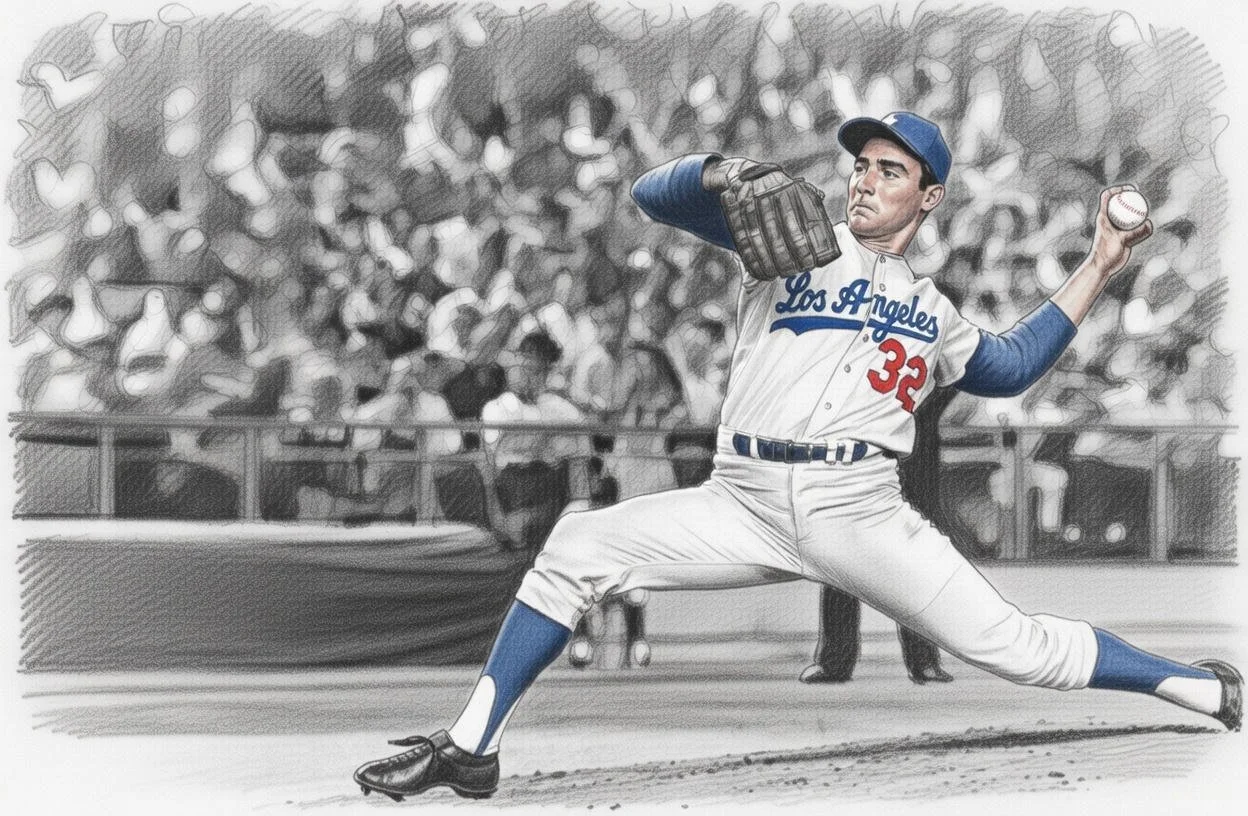
In the grand theater of American sports, where the crack of the bat echoes like a historical decree, few moments transcend the diamond to rewrite the narrative of identity and conviction. On October 6, 1965, as the Los Angeles Dodgers faced the Minnesota Twins in Game 1 of the World Series, Sandy Koufax—the southpaw sensation whose curveball bent reality—chose silence over stardom. It was Yom Kippur, the holiest day in Judaism, a time for atonement and reflection amid the fasting and prayers. Koufax, a Jewish American icon, sat out, honoring his faith over the roar of the crowd. This wasn't just a skipped start; it was a fastball hurled at the heart of assimilation, geopolitics, and cultural belonging in post-Holocaust America. In an era shadowed by the Cold War's ideological battles and the civil rights movement's fervor, Koufax's decision became a beacon, illuminating the intersection of sports, history, and the unyielding spirit of a people.
Sandy Koufax's ascent to superstardom was nothing short of meteoric, a tale forged in the crucibles of Brooklyn's streets and the sun-baked fields of Los Angeles. Born Sanford Braun in 1935 to Jewish parents in New York, Koufax adopted his stepfather's surname and honed his talents in the sandlots, where his arm was a weapon of precision and power. Signed by the Brooklyn Dodgers in 1954 as a "bonus baby"—a rule that mandated immediate major league roster spots for high-value prospects—Koufax struggled early. His first six seasons were marred by control issues: a 36-40 record, a 4.10 ERA, and more walks than strikeouts in some years. But then, like a historical pivot, everything changed in 1961. Advised by catcher Norm Sherry to ease his delivery, Koufax transformed. Over the next six years, he became the game's unchallenged dominator: a 129-47 record, a 2.19 ERA, 1,713 strikeouts, and four no-hitters, including a perfect game in 1965 against the Chicago Cubs.
His prowess wasn't mere statistics; it was artistry. Koufax's fastball hummed like a missile, his curveball dropped as if defying gravity—a blend of physics and poetry that left batters frozen. He led the National League in ERA five straight years (1962-1966), won three Cy Young Awards (when it was a single, league-wide honor), and earned the 1963 MVP despite pitching through excruciating elbow pain that would force his retirement at age 30. In the 1963 World Series, he dismantled the New York Yankees with two complete-game victories, including a 15-strikeout masterpiece in Game 1. Koufax wasn't just a pitcher; he was a force that reshaped baseball's landscape, proving that dominance could come from finesse as much as fury.
To the Jewish American community, Koufax represented far more than athletic excellence—he was a symbol of resilience and integration in a nation still grappling with its immigrant past. Post-World War II America was a melting pot bubbling with tensions: the Holocaust's horrors fresh in memory, antisemitism lingering in quotas and clubs, yet opportunities blooming for second-generation Jews. Koufax, with his unassuming demeanor and Brooklyn roots, embodied the American Dream through a Jewish lens. His success on the mound countered stereotypes of Jews as bookish or frail; here was a warrior, a "Left Arm of God," as sportswriters dubbed him, striking out the remnants of old prejudices. For a community navigating assimilation—balancing Shabbat with Saturday games, kosher laws with mainstream culture—Koufax was proof that one could thrive without erasure. Young Jewish boys idolized him, seeing in his strikeouts a metaphor for overcoming adversity. As author Jane Leavy noted in her biography, Koufax became "the New Patriarch," a figure whose achievements fostered pride amid the geopolitical shadows of the Cold War, where American Jews supported Israel while affirming their U.S. loyalty.
This cultural resonance peaked with the Yom Kippur decision of 1965. The Dodgers, fresh off a pennant clinched by Koufax's 26 wins and 382 strikeouts, entered the World Series as underdogs against the powerhouse Twins. Game 1 coincided with Yom Kippur, the Day of Atonement, when Jews fast and pray from sunset to sunset. Koufax, not particularly observant in daily life—he didn't keep kosher or attend synagogue regularly—had skipped starts on high holidays before, including Rosh Hashanah that year. But this was the World Series, the pinnacle, with millions watching. Manager Walter Alston tapped Don Drysdale instead, who got shelled in a 8-2 loss. Drysdale quipped to Alston, "I bet right now you wish I was Jewish, too."
The "controversy" wasn't outright backlash—most fans and media respected his choice—but it sparked debates on religion in public life. In 1965, America was amid cultural upheavals: Vietnam protests, civil rights marches, and Vatican II's reforms easing Catholic-Jewish tensions. Koufax's stand echoed Hank Greenberg's 1934 decision to sit out a pennant race game on Yom Kippur, but amplified by television's reach. Some critics whispered of team betrayal, but the overwhelming response was admiration. Jewish leaders hailed it; Rabbi Hillel Silverman called it "a kiddush Hashem," sanctifying God's name. For non-Jews, it humanized faith in a secular arena, challenging the "win at all costs" ethos.
The impacts rippled far beyond the series, which the Dodgers won in seven games, with Koufax hurling shutouts in Games 5 and 7 on two days' rest—his arm swollen, his legacy sealed. For Jewish Americans, it was empowering: in a time of rising intermarriage and identity dilution, Koufax showed faith could coexist with fame. Stories abound of Jews inspired to observe holidays more diligently; one rabbi even ordered tefillin for Koufax, symbolizing spiritual reconnection. Geopolitically, it resonated as Israel faced existential threats, with American Jews drawing strength from Koufax's quiet assertion of heritage.
Koufax's legacy on American culture endures like his unhittable curve. Retiring in 1966 due to arthritis, he became the youngest Hall of Famer in 1972, his plaque immortalizing a career of brilliance and brevity. But it's the Yom Kippur moment that cements his place in cultural lore. It influenced athletes like Shawn Green, who sat out on Yom Kippur in 2001 and 2004, and even non-Jewish players respecting religious observances. In popular culture, Koufax appears in films like The Life and Times of Hank Greenberg and books exploring Jewish sports heroes. His decision prefigured today's discussions on work-life balance, mental health days, and personal convictions in professional sports—think Colin Kaepernick's kneel or athletes' activism.
Moreover, Koufax's story intersects with broader historical currents. In the 1960s, as the U.S. supported Israel amid Arab-Israeli tensions, his prominence bolstered Jewish visibility. Today, amid rising antisemitism and debates on multiculturalism, Koufax reminds us of sports as a mirror to society. His refusal to pitch wasn't defiance but affirmation: of self, community, and the American ideal that allows such choices.
In the end, Sandy Koufax didn't just dominate baseball; he pitched a narrative of integrity that still strikes out division, one cultural inning at a time. His unpitched game in 1965 remains a masterclass in how sports, history, and identity collide to create legends.

