
He Came as a Player, Left as a God: Maradona’s Sacred Legacy in Naples
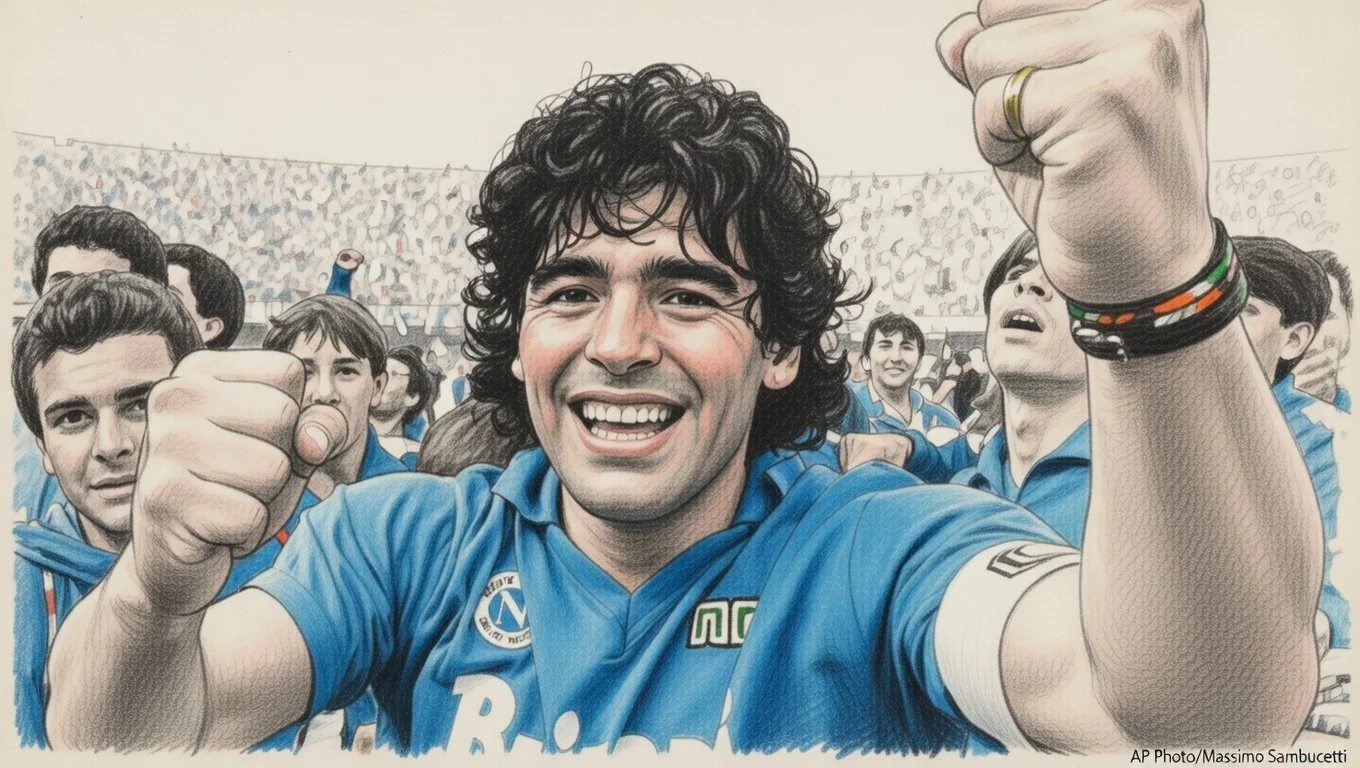
In the summer of 1984, a 23-year-old Diego Armando Maradona stepped off a plane in Naples and changed a city forever. For $10.5 million — a world record transfer fee at the time — the Argentine genius joined SSC Napoli, a club that had never won a major trophy and played in front of half-empty stadiums in one of Italy’s poorest and most stigmatized cities. What happened next is one of the most extraordinary stories in sports history: a footballing genius became a living deity.
To understand the magnitude of what Maradona did for Naples, you must first understand what Naples was in the 1980s.
The city was broke, chaotic, and looked down upon by the wealthy industrial north of Italy. Northern Italians openly called Neapolitans “Africans” and treated the south as a backward, criminal region. The Camorra (the Neapolitan mafia) controlled large parts of the economy. Unemployment was rampant. The San Paolo Stadium was crumbling. Napoli were perennial also-rans, the lovable losers of Italian football.
Then Maradona arrived.
In his very first season (1984–85), he scored 14 goals and provided 10 assists, immediately transforming the team. But it was the 1986–87 season that changed everything. Against all odds, Napoli won their first-ever Serie A title. The city exploded. For weeks, Naples was one never-ending street party. People danced on rooftops, hung banners from every balcony, and treated the Scudetto like a religious miracle. The team repeated the feat in 1989–90 and also won the UEFA Cup in 1989 and the Coppa Italia in 1987. For a brief, glorious period, the poorest major city in Italy was the football capital of Europe.
Maradona didn’t just play for Napoli — he became Napoli.
He embraced the city completely. He spoke the local dialect, ate the street food, dated local girls, and partied in the same neighborhoods as the fans. He openly criticized the northern clubs (Juventus, Milan, Inter) and the northern media that treated southern teams with contempt. He became the ultimate symbol of southern pride and resistance against northern elitism. In a deeply divided country, Maradona made an entire region feel seen, respected, and powerful for the first time in modern history.
The reverence went far beyond football. In Naples, Maradona is not remembered as a great player. He is remembered as a god.
After his death in November 2020, the city entered a period of genuine collective mourning. Thousands gathered outside the stadium. Murals appeared overnight. Shrines were built in alleyways. Babies were named Diego. The San Paolo Stadium was immediately renamed Stadio Diego Armando Maradona. Even today, in 2026, you can still see fresh flowers and candles placed at his statues and murals across the city. Some fans have tattoos of his face covering their entire backs. Others have built home altars with his picture next to the Virgin Mary.
This is not exaggeration. In Naples, Maradona sits somewhere between folk saint and demigod. There is a famous mural in the Quartieri Spagnoli that reads: “Maradona è Dio” (Maradona is God). During his playing days, fans would chant “Diego, Diego, è meglio di Pelé” (Diego is better than Pelé) and mean it with religious conviction.
The social and cultural impact was profound.
For a city long treated as Italy’s embarrassing younger brother, Maradona provided dignity. He gave people who felt powerless a sense of pride and identity. In a place where many young men saw limited options — emigration, crime, or dead-end jobs — he showed that someone from a poor background could conquer the world while staying true to his roots. He became a symbol of defiance, of southern resilience, and of the idea that talent and heart could overcome systemic disadvantage.
Even his flaws only deepened the love. Maradona’s well-documented struggles with addiction, his complicated personal life, and his rebellious personality made him even more human and relatable to the people of Naples. They didn’t want a perfect hero. They wanted someone who was theirs — flawed, passionate, and defiant.
More than 35 years after he left the club, Maradona’s presence is still felt in Naples every single day. His number 10 jersey is retired. His face appears on everything from coffee cups to street art. When Napoli finally won their third Scudetto in 2023, the celebrations were as much about honoring Maradona as they were about the current team.
No other athlete in modern sports history has been so completely absorbed into the identity of a city. Pelé is Brazil. Messi is Argentina. But Maradona is Naples. He didn’t just play for the club — he became the living embodiment of the city’s soul, its pain, its joy, and its unbreakable spirit.
In the end, Diego Maradona gave Naples something far more valuable than trophies. He gave them belief. He gave them pride. And in a city that had been told for centuries that it was second-class, he made them feel like kings.
That is why, in Naples, they don’t say “Maradona was a great footballer.”
They simply say: “Maradona was a god.”
And they mean it literally.
