
General George Patton and the 1912 Summer Olympics Controversy
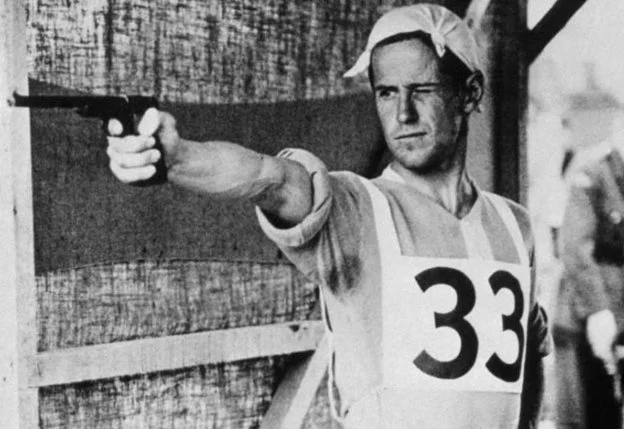
George S. Patton Jr., the legendary American general whose audacious leadership during World War II earned him the moniker "Old Blood and Guts," was not always defined by armored warfare and battlefield bravado. Long before he commanded tanks across Europe, Patton was a young U.S. Army lieutenant with Olympic aspirations. In the summer of 1912, at the age of 26, he represented the United States in the inaugural modern pentathlon at the Stockholm Olympics—a grueling event that tested the mettle of military officers through five disciplines: shooting, fencing, swimming, riding, and running. What should have been a straightforward competition turned into one of the most enduring controversies in Olympic history, centered on a disputed "missing bullet" in the shooting event. This incident not only cost Patton a potential medal but also highlighted issues of scoring fairness, national bias, and the intersection of military precision with athletic judgment. Over a century later, the debate persists: Was Patton robbed of gold, or was it simply a case of human error in an era of rudimentary judging?
To understand the controversy, it's essential to delve into Patton's early life and the context of the 1912 Games. Born on November 11, 1885, in San Gabriel, California, into a family with deep military roots—his grandfather was a Confederate colonel killed in the Civil War—Patton was destined for a soldier's path. He attended the Virginia Military Institute briefly before entering West Point in 1904, where he struggled academically but excelled in athletics and military drills. Graduating in 1909, Patton was commissioned as a second lieutenant in the cavalry, a branch that prized horsemanship and swordsmanship. His passion for sports was evident; he specialized in track and field and saw the modern pentathlon as an ideal showcase for a cavalry officer's skills.
The modern pentathlon itself was a novel addition to the Olympics, invented by Pierre de Coubertin, the founder of the modern Games, specifically to emulate the challenges faced by a soldier behind enemy lines. The event required competitors to ride an unfamiliar horse, fence with épées, swim a distance, shoot pistols, and run cross-country—all in sequence over several days. Restricted to active military officers, the 1912 competition drew 42 participants from various nations, but Patton was the sole American entrant. This isolation added pressure; he was not just competing for personal glory but carrying the weight of national representation in a sport dominated by Europeans, particularly the host Swedes.
The Stockholm Olympics, held from May 5 to July 27, 1912, were a spectacle of emerging modernity, with electric timing devices and international flair. Patton arrived prepared, having trained rigorously. He even designed his own uniform for the event, reflecting his flair for dramatics. The pentathlon began on July 7, and Patton's performance across the disciplines was a mix of triumphs and setbacks, ultimately leading to his fifth-place finish with 41 points—behind four Swedish athletes who swept the podium.
The shooting event, the first discipline, set the stage for the controversy. Competitors fired 20 shots at a target 25 meters away, using pistols of their choice. Most opted for lightweight .22-caliber models for accuracy, but Patton, true to his military ethos, selected a heavier .38-caliber Colt Special, the standard U.S. Army issue. This choice, while symbolically fitting, may have been a tactical misstep due to its greater recoil and larger bullets. After firing, judges inspected the target and counted only 17 hits. Patton vehemently protested, arguing that one of the "missing" shots had passed through an existing hole created by a previous bullet, enlarging it but not registering as a separate mark. Pointing to the clustered impacts, he insisted the round hadn't missed entirely but was obscured by the .38's destructive power.
The referees, however, rejected his claim. Without modern forensic tools like high-speed cameras or ballistic analysis, the decision relied on visual inspection alone. Patton was penalized heavily, ranking 21st out of 32 in shooting—a disastrous start that dropped him in the overall standings. Historians later speculated that if the shot had been counted, Patton could have climbed to third or even first place, potentially earning gold. The incident fueled accusations of bias, as the top spots went to Swedes, including gold medalist Gösta Lilliehöök. Patton's frustration was palpable; in a letter home, he lamented the judging but praised the event's sportsmanship overall.
Moving to the swimming portion, a 300-meter freestyle, Patton admitted he was no aquatic expert. He hadn't swum competitively in years and despised the sport, viewing it as unmanly compared to horseback pursuits. En route to Sweden aboard the SS Finland, he improvised training in a makeshift canvas pool on deck. During the race, he charged ahead aggressively but tired quickly, requiring assistance from a boathook to exit the water. Still, he placed seventh, a respectable showing given his aversion.
Fencing, the third event, played to Patton's strengths. Each athlete dueled every other in one-minute bouts, making it an endurance test of skill and strategy. Patton adopted an all-out offensive approach, thrusting relentlessly. He finished fourth, notably defeating the renowned French fencer Jean de Mas Latrie, whom he considered the world's best. This performance boosted his confidence and standings, showcasing the swordsmanship that would later make him the U.S. Army's Master of the Sword in 1919.
The equestrian phase involved a 5,000-meter steeplechase on an unfamiliar horse—a true test of adaptability. Patton's assigned mount was injured en route, so he borrowed a Swedish horse named Wohlgemuth. Despite the handicap, he navigated the course flawlessly, earning a perfect score and tying for first in that segment among those who completed it without faults, ultimately ranking sixth based on time.
The finale was a brutal 4,000-meter cross-country run through muddy forests in sweltering heat. Conditions were so harsh that one competitor died of heatstroke, and several collapsed. Patton, ever the charger, sprinted from the start without pacing himself. Accounts suggest he received a permissible opium injection for stamina, a common practice then. He led early but faltered near the end, walking the final 50 meters after a collapse. Crossing third, it was his strongest event.
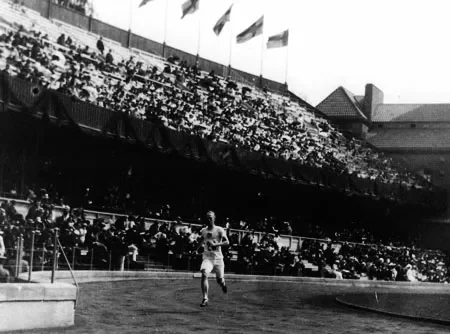
Despite strong showings in four events, the shooting penalty sealed Patton's fate at fifth overall—the highest non-Swede. The controversy lingered; Patton detailed it in his official report to the Army, arguing for rule changes. Some modern analyses, like those in Olympic archives, question whether his .38 caliber truly caused overlapping holes or if it was a genuine miss. Rusty Wilson's research suggests Patton's report may have exaggerated for effect, but the "missing bullet" myth endures as a symbol of what-ifs in sports history.
The 1912 experience shaped Patton profoundly. It honed his competitive spirit and leadership, qualities that propelled him through the Pancho Villa Expedition, World War I tank command, and WWII victories like the Sicily invasion and Battle of the Bulge. Selected for the 1916 Olympics (canceled by WWI), Patton's athletic pursuits transitioned to military innovation, including tank tactics. His Olympic tale, often romanticized, underscores themes of perseverance and injustice.
In retrospect, the controversy reflects the era's imperfect judging— no instant replays, just human eyes. Patton's protest, though unsuccessful, highlighted needs for standardization, influencing modern pentathlon evolutions: laser pistols since 2012, combined run-shoot events, and reduced distances for safety. Today, Patton is honored in the UIPM Hall of Fame, his 1912 saga a footnote to his legacy but a compelling story of the fine line between victory and defeat.
