
Barry Bonds: The Purest Hitter Baseball Has Ever Seen
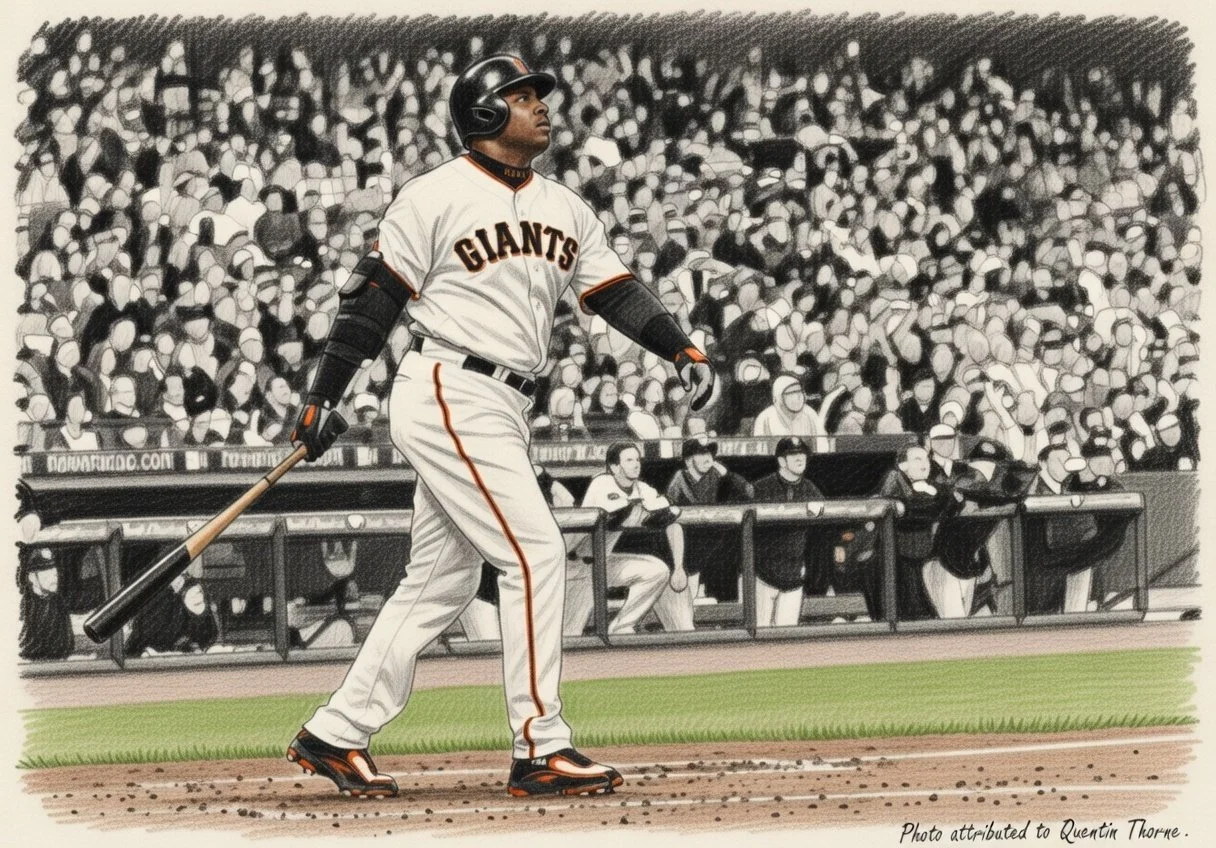
Forget the controversy, forget the debates, this article focuses on Barry Bonds the baseball player. There are hitters who are great. There are hitters who are legends. And then there is Barry Bonds — a singular, almost supernatural talent who bent the game of baseball to his will for two decades. When you strip away every external narrative and look only at what happened between the lines, Bonds stands alone as one of the most complete, dominant, and intellectually devastating offensive players in the history of the sport. His baseball genius wasn’t just about power. It was about vision, timing, discipline, and an almost preternatural understanding of the strike zone that made him nearly impossible to pitch to.
Born in 1964 in Riverside, California, Bonds grew up in the shadow of his father Bobby Bonds, a three-time All-Star and one of the game’s great power-speed threats. The younger Bonds was a baseball prodigy from the beginning. Drafted sixth overall by the Pittsburgh Pirates in 1985 out of Arizona State, he reached the majors in 1986 and immediately showed the world he was different. In his rookie season, he hit .223 with 16 home runs and 36 stolen bases. The power and speed were already there. The plate discipline that would later define him was still developing.
By 1990, Bonds had become the best player in baseball. That year he won the first of his record seven MVP awards, hitting .301 with 33 home runs, 114 RBI, and 52 stolen bases. He won his first Gold Glove in left field and led the Pirates to the NL East title. The following year, 1991, he nearly won the Triple Crown, finishing with a .311 average, 25 home runs, and 116 RBI while stealing 43 bases. He was a complete player — a five-tool threat who could hit for average, hit for power, run, field, and throw.
In 1992, Bonds delivered one of the greatest individual seasons in Pirates history: .311 average, 34 home runs, 103 RBI, and 39 stolen bases. He won his second straight MVP and led Pittsburgh back to the playoffs. But the Pirates’ ownership was already in financial trouble. After the 1992 season, they let him walk as a free agent. The San Francisco Giants signed him to the richest contract in baseball history at the time — six years, $43.75 million.
What happened next was one of the most dominant stretches any hitter has ever produced.
From 1993 to 2004, Barry Bonds played baseball on a level that felt almost unfair. In 1993, his first year in San Francisco, he hit .336 with 46 home runs and 123 RBI, winning his third MVP. In 1996, he became the first player in history to hit 40 home runs and steal 40 bases in the same season (42 HR, 40 SB). In 2001, he shattered baseball’s most sacred record, hitting 73 home runs in a single season. He also drew 177 walks that year — the most in MLB history at the time.
But the numbers only tell part of the story.
Bonds’ genius was in how he controlled at-bats. He had the best eye in baseball history. Pitchers couldn’t throw him a strike without consequence. In 2002, he walked 198 times — an absurd 32.6% of his plate appearances. In 2004, he walked 232 times, including 120 intentional walks. No one has ever been pitched around like that. He turned the strike zone into his personal playground, forcing defenses to play him in ways that had never been seen before.
His swing was poetry. Short, compact, and violently efficient. He generated massive power from a relatively compact frame (6'1", 228 lbs at his peak) through perfect timing and hip rotation. The ball didn’t just leave the park — it exploded off his bat. Opposing pitchers described facing him as “trying to pitch to a ghost.” They knew they were going to get beat, they just didn’t know how.
Bonds’ defensive excellence is often overlooked. He won eight Gold Gloves in left field, showcasing elite range, arm strength, and instincts. He was a legitimate five-tool player who could beat you with his bat, his legs, and his glove.
The list of accomplishments is staggering:
762 career home runs (all-time leader)
2,558 career walks (all-time leader)
7 MVP awards (all-time leader)
14 All-Star selections
8 Gold Gloves
12 Silver Slugger awards
.298 career batting average
1,996 career RBI
514 career stolen bases
He is the only player in major league history to hit 500 home runs and steal 500 bases. He led the league in on-base percentage 10 times. He posted a career OPS of 1.051 — the highest of any player with at least 9,000 plate appearances.
What made Bonds truly special wasn’t just the numbers. It was the way he elevated the entire sport. He forced teams to rethink how they pitched, how they defended, and how they evaluated talent. The intentional walk became a strategic weapon because of him. Advanced analytics — the kind that now dominate baseball — were born partly out of trying to understand and neutralize what Barry Bonds was doing at the plate.
His impact on the Giants organization was profound. When he arrived in 1993, the team was mediocre. By the time he left after the 2007 season, he had transformed them into perennial contenders and helped create the modern identity of the franchise. The Giants’ three World Series titles in 2010, 2012, and 2014 were built on the foundation of excellence he established.
Barry Bonds played the game with an intelligence and ruthlessness that few have matched. He studied pitchers the way grandmasters study chess. He knew their tendencies, their release points, and their weaknesses better than they knew themselves. He turned every at-bat into a chess match — and he almost always won.
In the end, Barry Bonds wasn’t just a great hitter. He was a baseball savant whose genius forced the game to evolve around him. The way pitchers approached the strike zone, the way teams built their lineups, the way analysts evaluated value — all of it changed because of what Barry Bonds did between the white lines.
He was, quite simply, the most complete and dominant offensive player the sport has ever seen.
