
From Virtue to Vengeance: How Stone Cold Steve Austin Marked a Key Shift in American Culture
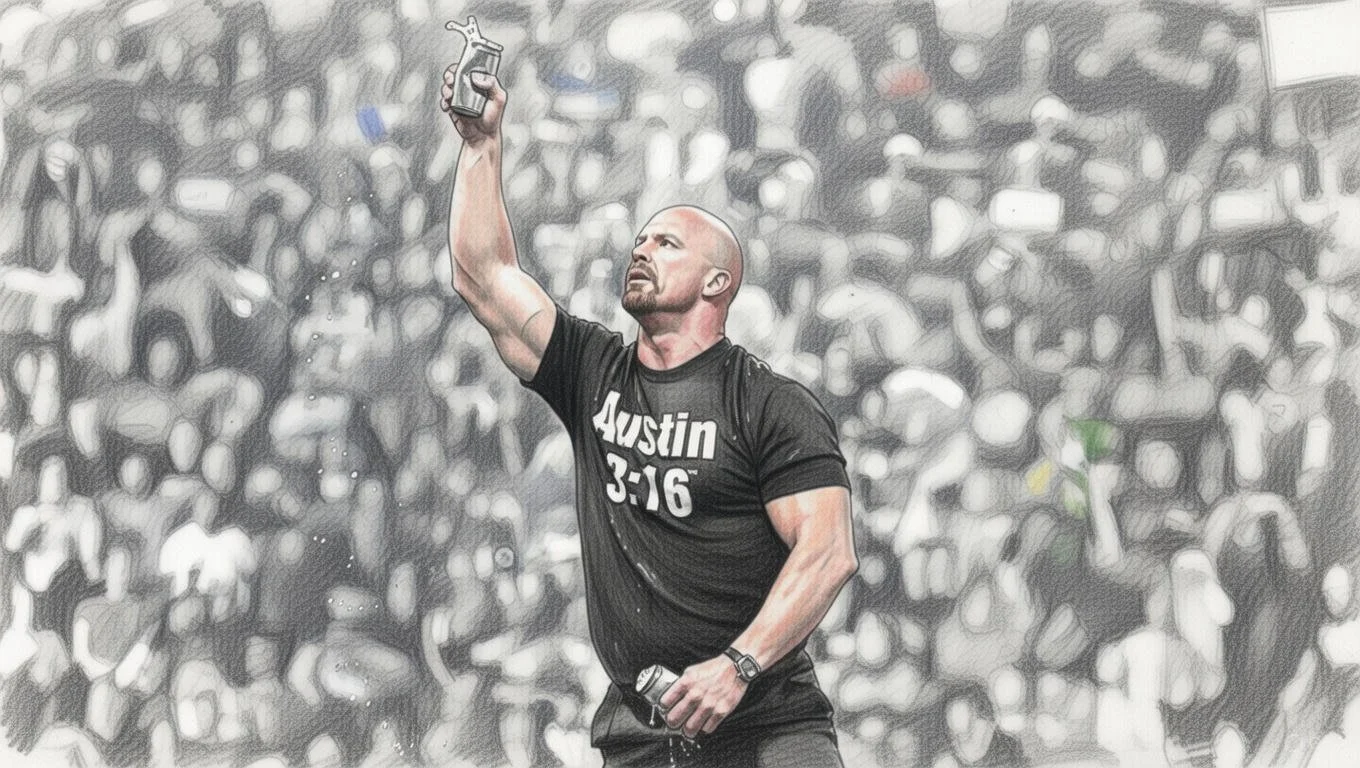
In the neon-lit arenas of the late 1990s, where sweat and spectacle collided under the roar of pyrotechnics, a bald-headed Texan with a goatee and a penchant for profanity shattered the mold of American heroism. On March 23, 1997, at WrestleMania 13, "Stone Cold" Steve Austin—bloodied and defiant—refused to submit to Bret Hart's Sharpshooter, passing out rather than tapping out. As the crowd erupted, Austin's anti-hero persona crystallized, marking a seismic shift in professional wrestling and, by extension, American culture. Gone were the days of virtuous supermen like Hulk Hogan, who preached vitamins and prayers; in their place rose a vengeful everyman, flipping off authority and chugging beers. This wasn't just entertainment—it was a mirror to a nation grappling with post-Cold War disillusionment, economic turbulence, and a craving for rebellion. Austin's rise during the WWF's Attitude Era encapsulated a pivotal moment, transforming sports entertainment into a cultural juggernaut that reflected and influenced the raw, unfiltered spirit of 1990s America.
Steve Austin's journey to superstardom was a gritty odyssey, forged in the underbelly of wrestling's regional circuits before exploding onto the national stage. Born Steven James Anderson in 1964 in Austin, Texas—later adopting the city's name as his own—he grew up in a working-class family, embodying the blue-collar ethos that would define his character. After a stint in college football, Austin entered pro wrestling in 1989, training under Chris Adams and debuting in the United States Wrestling Association. His big break came in World Championship Wrestling (WCW) as "Stunning" Steve Austin, where he formed the Hollywood Blondes tag team with Brian Pillman, capturing the Tag Team Championships in 1993. But WCW's politics sidelined him; injured and underutilized, Austin was unceremoniously fired in 1995 while recovering from a triceps tear.
Undeterred, Austin pivoted to Extreme Championship Wrestling (ECW), where his sharp promos—mocking WCW boss Eric Bischoff and channeling real-life frustrations—honed his edge. It was here that the seeds of "Stone Cold" were planted: a no-nonsense, beer-swilling tough guy who spoke truth to power. In late 1995, the World Wrestling Federation (WWF, now WWE) signed him, initially as "The Ringmaster" under manager Ted DiBiase. The gimmick flopped—Austin later called it "lame"—but a pivotal opportunity arose at King of the Ring 1996. After winning the tournament by defeating Jake "The Snake" Roberts, who had a born-again Christian persona, Austin delivered his infamous promo: "Austin 3:16 says I just whipped your ass!" The line, riffing on Roberts' biblical references, exploded. T-shirts flew off shelves, and "Austin 3:16" became a cultural mantra, signaling the dawn of the Attitude Era.
This rise coincided with WWF's desperate pivot. In the mid-1990s, WCW's Monday Nitro—bolstered by stars like Hulk Hogan and the New World Order—dominated ratings in the "Monday Night Wars." WWF, under Vince McMahon, responded by ditching family-friendly fare for edgier content: more violence, sexuality, and reality-based storylines. Austin became the era's avatar, his feuds embodying the shift. His rivalry with McMahon, starting in 1997, was genius—McMahon as the tyrannical boss, Austin as the rebellious employee stunning him with Stone Cold Stunners. It tapped into real-world resentments: corporate downsizing, wage stagnation, and anti-establishment sentiments in a post-Reagan era where the American Dream felt elusive for many.
Austin's character reflected a broader cultural metamorphosis in 1990s America. The decade began with the Gulf War's patriotic fervor but soured amid scandals like Monica Lewinsky, economic bubbles, and the rise of grunge and hip-hop challenging norms. Heroes evolved from virtuous icons to flawed anti-heroes—think Tony Soprano or Quentin Tarantino's vigilantes. Austin, with his middle fingers, profanity-laced tirades, and beer bashes, personified this vengeance over virtue. He wasn't a role model; he was relatable rage personified. As wrestling historian David Shoemaker noted, Austin represented "the id of the American working class," channeling frustrations from NAFTA's job losses to the dot-com boom's inequalities. Geopolitically, post-Cold War America basked in unipolar dominance, yet domestically, cynicism brewed. Austin's anti-authority streak mirrored movements like the anti-globalization protests, where everyday folks railed against elites.
His impact was immediate and profound. By 1998, Austin headlined WrestleMania XIV, defeating Shawn Michaels for the WWF Championship with Mike Tyson as enforcer—a crossover that blurred sports and entertainment lines. Ratings soared; WWF overtook WCW, peaking at 8.1 for a 1999 Raw episode. Merchandise sales exploded—Austin 3:16 shirts alone grossed millions. Culturally, his catchphrases infiltrated pop culture: "What?" chants at events, "Hell yeah!" in everyday lingo. He appeared on shows like Nash Bridges and hosted Saturday Night Live, cementing wrestling's mainstream resurgence. For the Jewish American community? Wait, no—that's Koufax. For broader America, Austin democratized heroism, showing that vengeance could be virtuous in a flawed world.
The Attitude Era, propelled by Austin, intersected with historical shifts. As the U.S. navigated Clinton-era prosperity amid moral ambiguities, wrestling became a pressure valve. Austin's feuds—like the beer truck dousing the Corporation in 1999—were cathartic spectacles, echoing labor unrest and cultural backlash against polished corporatism. In a time when geopolitics saw NATO expansions and Kosovo interventions, Austin's isolationist, self-reliant vibe resonated with a public weary of endless engagements. His persona influenced media: reality TV's rise, with its unscripted drama, owed a debt to WWF's blurred lines between kayfabe and reality.
Yet, Austin's reign wasn't without controversy. Neck injuries from a 1997 piledriver by Owen Hart sidelined him, forcing a 1999 surgery and brief retirement. His 2002 walkout amid creative differences highlighted the era's burnout. Domestically, critics decried the Attitude Era's misogyny and violence, prompting parental advisories. But its legacy endures: WWF's victory in the ratings war led to the 2001 WCW purchase, monopolizing the industry. Austin retired in 2003 after WrestleMania XIX against The Rock, but his influence persists in modern WWE stars like CM Punk or Becky Lynch, who channel anti-establishment fire.
Austin's mark on American culture is indelible. He shifted sports entertainment from cartoonish morality plays to nuanced narratives, paving the way for UFC's raw authenticity and streaming-era content. In history's lens, he captured a pivotal moment: the 1990s' transition from optimism to cynicism, where vengeance supplanted virtue as the people's creed. Today, amid political polarizations and social media rebellions, Austin's spirit lives on—proof that in America's cultural arena, the underdog's roar can redefine the game.
From the squared circle to the cultural zeitgeist, Stone Cold Steve Austin didn't just win matches; he won hearts by embracing the vengeance within us all. His era reminds us how sports, at their core, reflect the soul of a nation—raw, resilient, and ready to stun the status quo.
