
Echoes of Unity: The Korea Unification Flag in Sports and Its Political Ripples
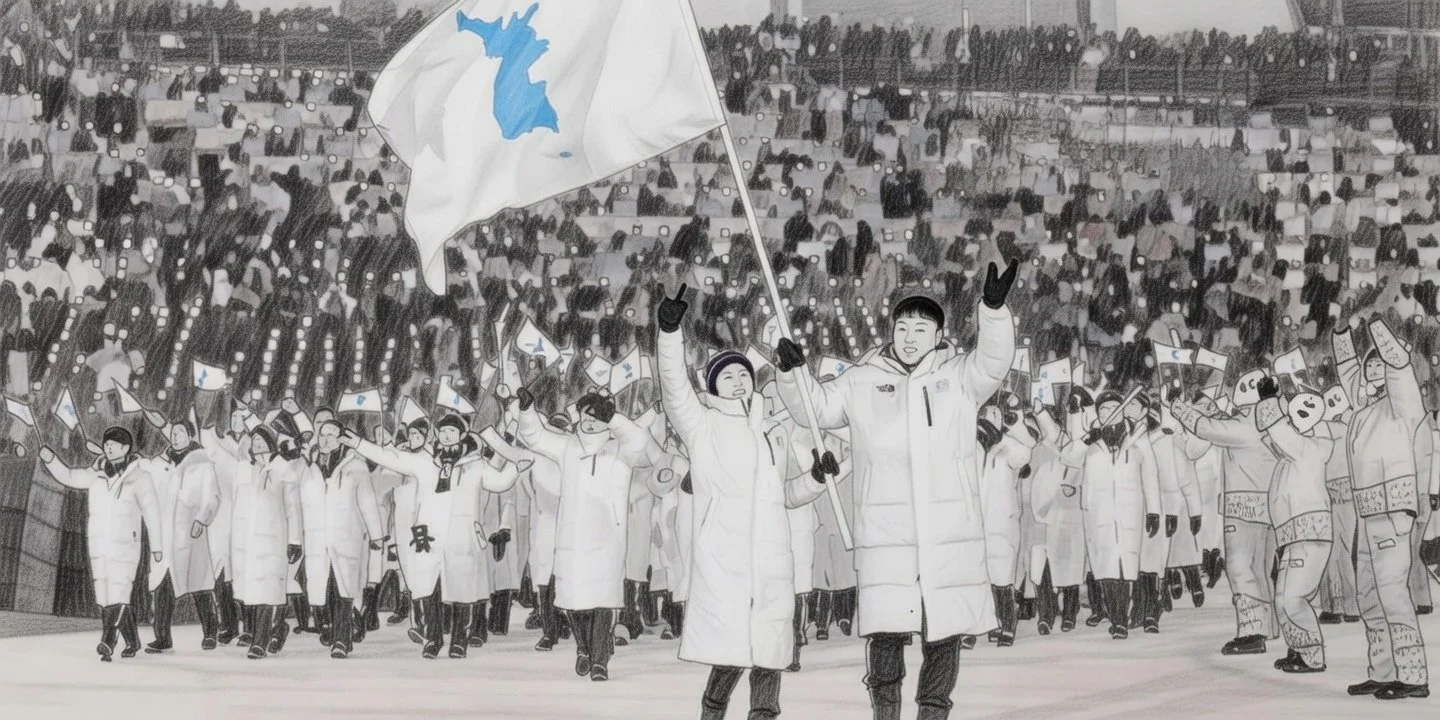
Imagine the electric chill of PyeongChang Olympic Stadium on February 9, 2018, where 35,000 spectators brave sub-zero temperatures, their breaths fogging the night air as the opening ceremony unfolds. Amid dazzling fireworks and K-pop beats, athletes from 92 nations parade— but all eyes fix on the joint Korean delegation: 22 North Korean and South Korean competitors marching as one, clad in white uniforms, carrying a single flag. It's not the blue-and-red Taegukgi of the South or the red star of the North; instead, a stark white banner with a blue silhouette of the undivided Korean Peninsula flutters proudly, symbolizing a dream deferred amid decades of division. This moment, broadcast to billions, wasn't mere pageantry—it was a political statement, where sports bridged a demilitarized zone, if only for a night. For those tracing the threads of diplomacy through culture and fans captivated by sports' unifying power, the Korea Unification Flag represents hope amid hostility, a symbol wielded in Olympics and beyond to nudge the needle on inter-Korean relations.
The Unification Flag, often called the Korean Peninsula Flag, emerged in the late 1980s amid tentative North-South dialogues. Designed as a simple white field with a light blue map of the Korean Peninsula (including disputed islands like Dokdo/Takeshima and Jeju), it avoids national symbols to emphasize shared geography and heritage. First proposed during 1989 talks for joint teams, it debuted at the 1991 World Table Tennis Championships in Chiba, Japan, where a unified Korean team competed as "Korea," winning gold in women's doubles—a breakthrough that hinted at sports' diplomatic potential. The flag's evolution reflects geopolitical shifts: in 2003, disputed islets were added to assert claims against Japan, but removed in 2018 at IOC request to avoid controversy. Its use signals thaws in relations, often tied to summits or economic overtures, making it a barometer for the Korean divide.
The Olympics have been the flag's most visible stage, amplifying its message to a global audience. The first Olympic appearance came at the 2000 Sydney Games, where North and South marched together under it during opening and closing ceremonies, though competing separately—a symbolic gesture amid the Sunshine Policy under South Korean President Kim Dae-jung, who won the Nobel Peace Prize that year for inter-Korean engagement. This set a pattern: joint marches in 2004 Athens and 2006 Turin Winter Olympics, fostering brief unity amid stalled talks. The pinnacle was 2018 PyeongChang, hosted by South Korea during a diplomatic bloom under President Moon Jae-in and North Korean leader Kim Jong-un's summits. Not only did they march together, but formed a joint women's ice hockey team—the first unified Olympic squad—competing under the flag with a special "KOR" code. This thawed relations temporarily, leading to family reunions and denuclearization talks, though tensions resurfaced by 2020. At Tokyo 2020 (delayed to 2021), the flag appeared in limited capacity due to COVID restrictions and North Korea's boycott over pandemic fears, but its absence underscored missed opportunities.
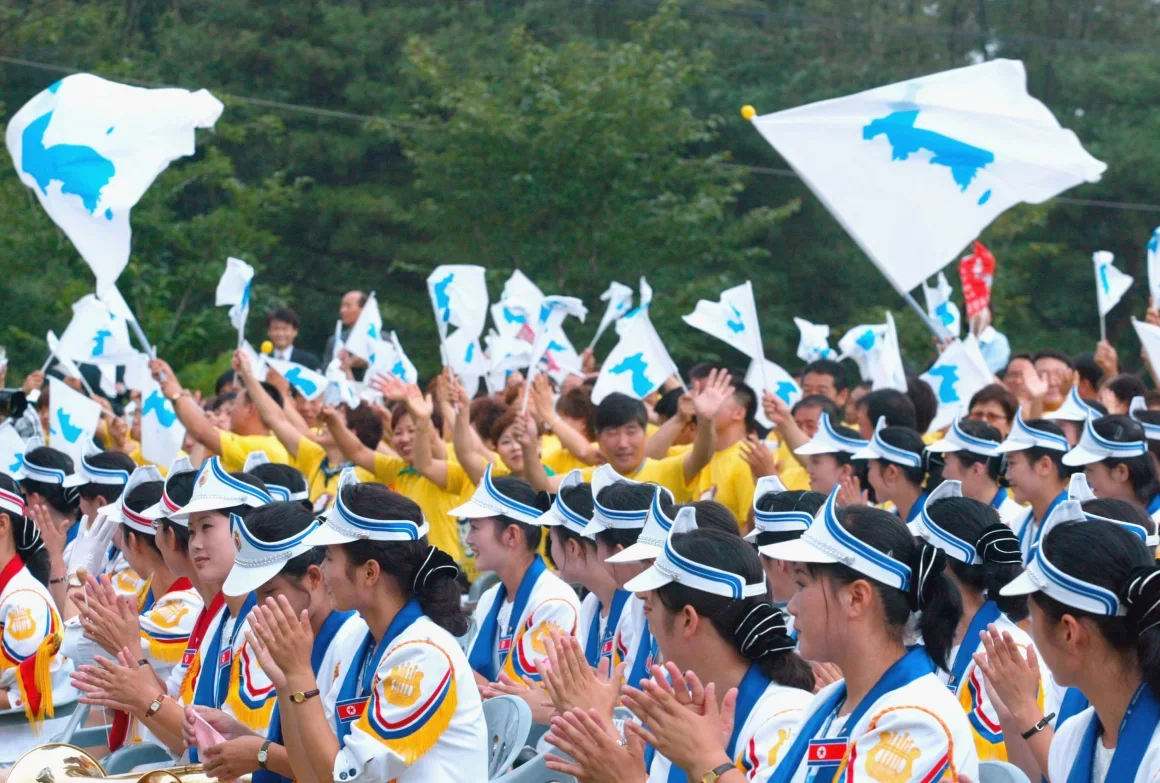
South Korean supporters wave unified flags at the World Student Games in August 2003 in Daegu, South Korea.
Beyond Olympics, the flag has featured in various events, often aligning with diplomatic highs. At the 1991 Table Tennis Worlds, the unified team's success sparked brief euphoria. In Asian Games—2002 Busan, 2014 Incheon, 2018 Jakarta—the flag flew over joint teams in sports like basketball and rowing, yielding medals and headlines. The 2018 Asian Games saw unified canoeing and basketball squads, with women's basketball gold symbolizing sisterhood amid summits. Other instances include the 1999 Asian Winter Games and 2003 Universiade, where joint marches fostered people-to-people ties. These uses often precede or follow inter-Korean talks, like the 2018 flag appearances coinciding with Panmunjom Declaration.
Politically, the flag's implications are profound, embodying aspirations for reunification while exposing divisions. For North Korea, it's a propaganda tool to project peaceful intent, countering isolation from sanctions and nuclear standoffs. South Korea uses it to advance engagement policies, like Moon's "peace economy" vision. Globally, it signals de-escalation, earning praise from the IOC for promoting Olympic ideals of unity—IOC President Thomas Bach called the 2018 joint team "a powerful message of peace." Yet controversies abound: in South Korea, conservatives criticize it for diluting national identity, equating it to "capitulation" or ignoring North's human rights abuses. Protests erupted in 2018, with critics burning the flag, viewing it as undermining South's sovereignty. Island disputes—Dokdo added in 2003, removed in 2018—highlight territorial sensitivities with Japan. The flag's use often correlates with leadership: liberal South Korean presidents like Kim Dae-jung, Roh Moo-hyun, and Moon embraced it, while conservatives like Lee Myung-bak and Yoon Suk-yeol shunned joint efforts amid North's provocations. It influences diplomacy: 2018's sports unity paved for Trump-Kim summits, though fleeting.
Culturally, the flag fosters shared Korean identity, evoking "hanminjok" (one people) amid division since 1945. For diaspora Koreans, it's emotional—unification dreams persist despite generations apart. Youth in South, influenced by K-pop and dramas romanticizing North-South romances (e.g., "Crash Landing on You"), see it positively, boosting support for engagement. Globally, it promotes Korea as a peace-seeking entity, countering North's rogue image.
The Korea Unification Flag endures as sports diplomacy's emblem, a beacon in turbulent relations. It highlights how games can humanize divides, fostering dialogue where politics falter. But as tensions persist, one must ask: In an era of nuclear shadows, could this flag one day wave over a truly united Korea?
