
The 8.06-Meter Miscalculation
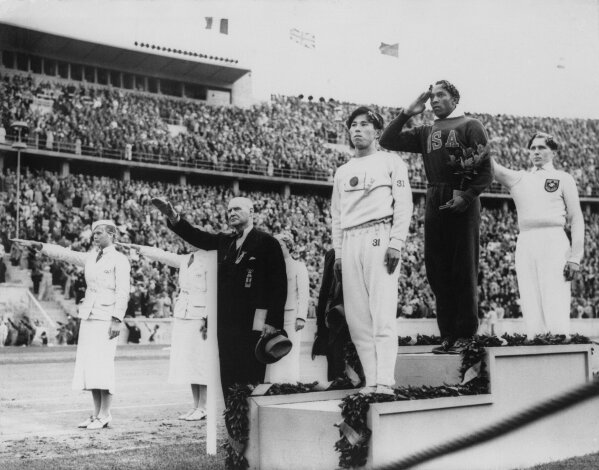
Jesse Owens in front of Hitler at Berlin Olympics | AP News
The 8.06-Meter Miscalculation
Everyone knows the iconic images: Jesse Owens on the podium in Berlin's Olympic Stadium, four gold medals gleaming around his neck, the American flag rising as the crowd roars in a language foreign to him. We cherish these moments as a triumphant postcard from history—"Racism defeated, humanity victorious; track and field prevails over hatred."
But the real story is subtler, more ironic, and ultimately more devastating to the Nazi regime. The Nazis didn't lose their propaganda battle because Jesse Owens was faster than their athletes. They lost because they believed their own pseudoscience so deeply that they couldn't conceive of genuine human connection across racial lines.
Let me explain.
By 1936, Nazi "racial science" wasn't some extremist fringe theory—it was state-sponsored consensus. The regime's anthropologists and sports officials produced reams of data: skull measurements, caliper readings of limbs, charts claiming the "Nordic type" excelled in speed, strength, endurance, and even moral willpower. This wasn't hidden; it was taught in schools and promoted as fact.
When Berlin was awarded the 1936 Olympics back in 1931—before Hitler's rise—the Nazis seized it as the ultimate stage. They poured massive resources into the event: constructing the monumental 100,000-seat Olympic Stadium, inventing the modern torch relay tradition, and commissioning Leni Riefenstahl to film it all in groundbreaking Technicolor for her propaganda masterpiece Olympia. The plan was straightforward: showcase Aryan athletes dominating the world, convincing global audiences of a new racial order.
The regime masked its antisemitism temporarily—removing some anti-Jewish signs, allowing limited Jewish participation elsewhere—to avoid a full boycott. The Games became a dazzling spectacle of efficiency and grandeur, broadcast via early television and radio to millions.
There was just one uncontrollable factor: the athletes themselves, particularly from the United States. And among them, one standout: a 22-year-old from Alabama, son of sharecroppers and grandson of enslaved people, who had already shattered records at Ohio State University.
Jesse Owens arrived in Berlin as the world record holder in the long jump and a favorite in the sprints. The Nazis believed they had prepared for him. Their star long jumper, Carl "Luz" Long—blond, blue-eyed, the epitome of Aryan ideals—had leaped a European record of around 7.82 meters earlier that year. Officials rehearsed victory ceremonies assuming Long would prevail.
The long jump competition on August 4, 1936, unfolded before 110,000 spectators. In qualifying, Owens surprisingly fouled his first two attempts—stepping over the takeoff board, a common issue under pressure. One more foul, and he'd be eliminated.
Here's the delicious irony at the heart of the story. Luz Long, the German champion and supposed embodiment of racial superiority, approached Owens. He introduced himself and offered quiet advice: move your starting mark back several inches to ensure a safe, legal jump, even if it slightly reduces distance. Owens followed the suggestion, qualified comfortably, and advanced to the final.
In the final, the duel intensified. Long set an early Olympic record, but Owens responded with leaps that broke it multiple times. His winning jump: 8.06 meters (26 feet, 5¼ inches)—an Olympic record that stood for decades. Long took silver with 7.87 meters.
Then came the moment that undercut everything. As Owens secured gold, Long was the first to congratulate him publicly—embracing him in the sandpit, smiling broadly, arm around his shoulder. Captured on film and in photographs, this friendly gesture between a Black American and a German "Aryan" was broadcast worldwide.
The Nazi theory of unbridgeable racial hierarchy didn't crumble under a mere stopwatch. It fractured under a simple act of sportsmanship: a handshake, an embrace, genuine respect.
One human gesture from the supposed "master race" toward a Black athlete demolished more propaganda than any editorial or protest could. It humanized the "other" in a way abstract ideology couldn't counter.
The ripple effects were profound, though not immediate.
American media highlighted Owens' triumphs, often noting Hitler's absence from the stadium during some victories (though the famous "snub" story—that Hitler stormed out in rage—is largely myth; he had stopped congratulating winners after the first day to avoid favoritism accusations). Black Americans celebrated a hero from their community atop the podium while the world's most powerful dictator watched from afar.
White Americans, many still entrenched in Jim Crow segregation, faced uncomfortable hypocrisy: cheering a Black athlete's global dominance while denying basic rights at home. Owens himself later noted he wasn't invited to the White House—President Franklin D. Roosevelt congratulated only white Olympians—saying, "Hitler didn't snub me; it was our president who snubbed me."
Historians debate whether Owens' wins truly "destroyed" Nazi racial myths. Germany topped the medal table with 89 medals (U.S. second with 56), a propaganda win overall. The regime downplayed Black athletes' successes, claiming they were "primitives" with natural physical advantages but lacking "Aryan" intellect or discipline.
Yet Owens' visibility—winning four golds (100m, 200m, long jump, 4x100m relay)—exposed the regime's central lie vividly. His friendship with Long endured; they corresponded until war intervened, and Long (who died fighting in World War II) asked Owens in a final letter to visit his son and explain their bond.
Sports don't always rewrite history outright. But in 1936, one leap, one embrace, one set of photographs pierced the Nazi facade cleaner than any army could.
The regime built the grandest stage in history to proclaim supermen.
Jesse Owens—and Luz Long's grace—used it to prove them profoundly wrong.
The world hasn't fully recovered from that revelation.
Sometimes the greatest revolutions aren't waged with weapons or speeches.
They're won on starting blocks, with a measuring tape...
And sealed with humanity.