
The Shadow Over the Rings: The 1972 Munich Olympics Massacre
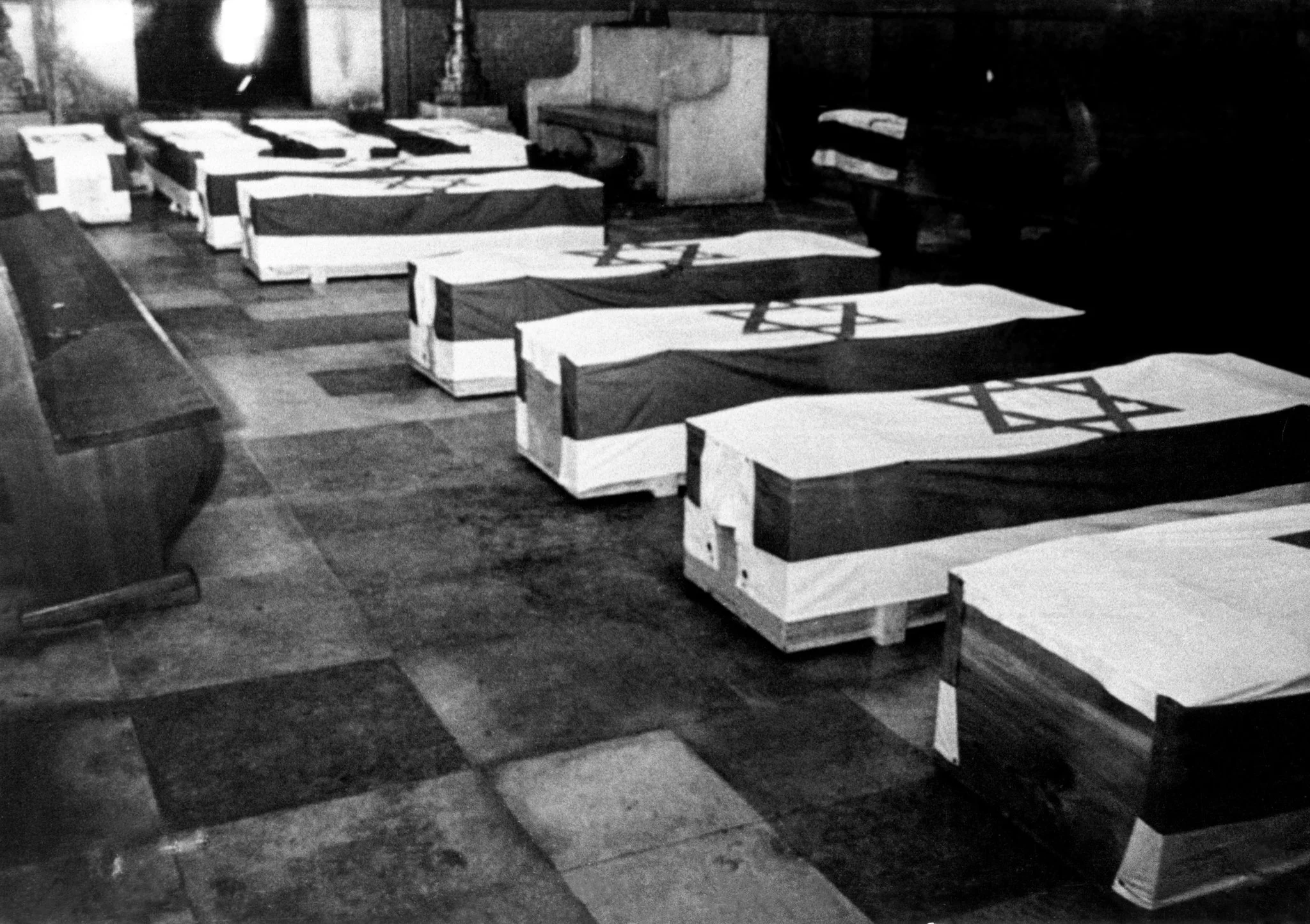
Long-Hidden Details Reveal Cruelty of 1972 Munich Attackers - The New York Times
Picture the vibrant hum of Munich's Olympic Village on September 5, 1972, where athletes from 121 nations mingle under the banner of peace, their dreams fueled by the roar of cheering crowds and the promise of gold. The Games, dubbed the "Happy Olympics" by West German organizers, are a deliberate antidote to the dark legacy of Berlin 1936—a showcase of a rebuilt, democratic Germany emerging from the ashes of World War II. But in the predawn hours, that illusion shatters like glass under gunfire. Eight Palestinian commandos from the Black September group scale a fence, armed with Kalashnikovs and grenades, storming the Israeli team’s apartments. What follows is a 20-hour siege that transforms the world’s greatest sporting event into a battlefield, claiming 17 lives and forever altering the intersection of athletics and global conflict. For those who revere the strategy of military campaigns and the grit of competitive sports, the Munich Massacre isn’t just a tragedy—it’s a stark reminder of how vulnerability in the arena can mirror the perils of the front lines.
The 1972 Summer Olympics were meant to symbolize renewal. Hosted in Munich from August 26 to September 11, they featured 7,134 athletes competing in 195 events, with innovations like electronic timing and the first official Olympic mascot, Waldi the dachshund. West Germany invested over $1 billion (equivalent to about $7 billion today) to host the Games, aiming to distance itself from the Nazi-tainted 1936 Berlin Olympics. The political backdrop was tense: the Cold War divided the world, with East and West Germany competing separately for the first time, and the Israeli-Palestinian conflict simmered amid ongoing Arab-Israeli wars. The Games proceeded amid calls for boycotts over Rhodesia's apartheid policies, but the focus was on unity—until Black September struck. Black September, a splinter group from the Palestine Liberation Organization (PLO), sought to highlight the Palestinian cause by demanding the release of 234 prisoners held in Israel and West Germany.
The assault began at 4:30 a.m. The terrorists, disguised in tracksuits and carrying duffel bags of weapons, entered Apartment 1 at 31 Connollystrasse, where the Israeli wrestling and weightlifting teams were housed. They immediately killed wrestling coach Moshe Weinberg and weightlifter Yossef Romano, who resisted. Nine others—fencers, wrestlers, and coaches—were taken hostage. The attackers issued their demands via a note thrown from the window: release the prisoners or face executions starting at 9 a.m. West German authorities, unprepared for such a crisis, scrambled. Chancellor Willy Brandt's government, committed to a "soft" security approach to avoid militaristic optics, had only 26 unarmed guards in the Village. Negotiations dragged on, with deadlines extended five times as the world watched live on television—a media frenzy that amplified the terrorists' message but complicated rescue efforts.
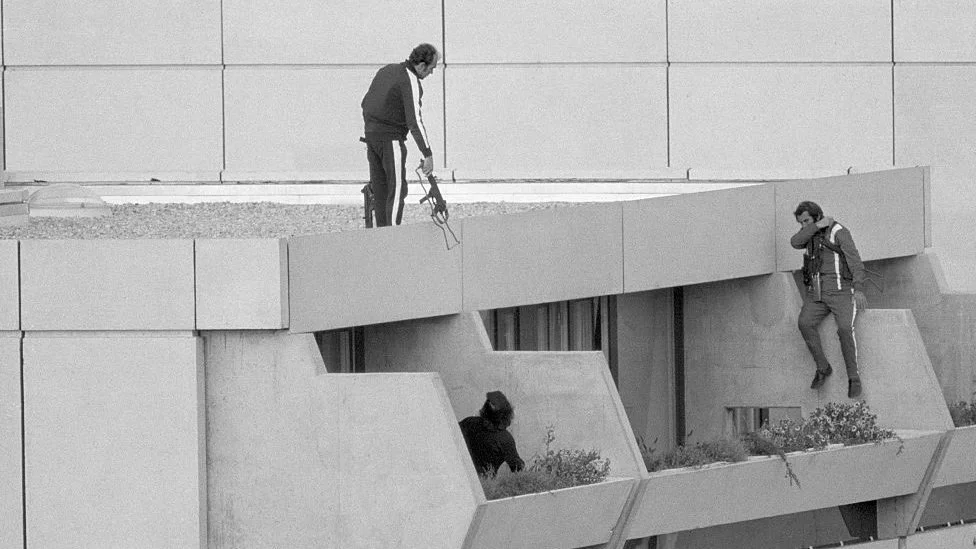
Munich Olympics massacre compensation deal struck
By evening, a deal seemed struck: the terrorists and hostages would be flown to Cairo. But it was a ruse. At Fürstenfeldbruck Air Base, 20 miles away, West German police planned an ambush. Five snipers—none specially trained for hostage rescues—were positioned around a Boeing 727. As the group arrived via helicopters around 10:30 p.m., chaos erupted. A sniper fired prematurely, killing one terrorist but alerting the others. The commandos opened fire on the hostages, tossing a grenade into one helicopter that exploded, killing all inside. In the ensuing shootout, five terrorists and one policeman died, but all nine remaining hostages perished—bound and helpless in the crossfire. The botched operation exposed glaring flaws: no night-vision gear, inadequate training, and a failure to anticipate the terrorists' ruthlessness.
The massacre's immediate toll was devastating. Eleven Israelis dead (including the two initial victims), plus the policeman and five terrorists. The Games paused for a 34-hour memorial, attended by 80,000, where IOC President Avery Brundage controversially declared, "The Games must go on," drawing criticism for equating the tragedy with prior boycotts. Israel responded with "Operation Wrath of God," a covert campaign assassinating Black September leaders over years, immortalized in films like Munich. Globally, the event shattered the Olympics' apolitical facade, leading to enhanced security protocols. Future Games saw armed guards, surveillance, and anti-terror units—echoing modern military tactics in sporting venues.
For military history enthusiasts, Munich highlights the evolution of asymmetric warfare. Black September's attack was a classic guerrilla operation: low-cost, high-impact, using the Olympics' global stage for propaganda. It forced nations to rethink urban counter-terrorism, birthing elite units like Germany's GSG 9, formed just months later. In sports terms, it was a gut punch to the ideal of peaceful competition. Athletes like Mark Spitz, who won seven golds, fled amid fears, while the Israeli team's survivors carried lifelong scars. The massacre underscored how sports can become battlegrounds, where national pride intersects with geopolitical vendettas.
The long-term impact reshaped both sports and security. The IOC established a permanent memorial in 2017, but debates linger over moments of silence at openings—rejected in 2012 but observed in Tokyo 2021. Militarily, it accelerated the professionalization of hostage rescue, influencing operations like Entebbe in 1976. Culturally, it humanized the Israeli-Palestinian conflict for Western audiences, though it hardened positions on both sides. Black September's goal—to spotlight Palestinian plight—succeeded in visibility but failed in sympathy, as global outrage focused on the innocent athletes slain.
In the annals of sports and military history, Munich 1972 stands as a watershed: the day terrorism invaded the sanctuary of the Games, forcing a reevaluation of vulnerability in global spectacles. It blended the thrill of athletic achievement with the terror of ideological violence, reminding us that even in pursuit of peace, shadows lurk. But as we honor the fallen, one must ask: In an era of heightened security, could such a tragedy ever unfold again on the Olympic stage?
