
Igniting a Revolution: Fernando Valenzuela and the Fernandomania Era
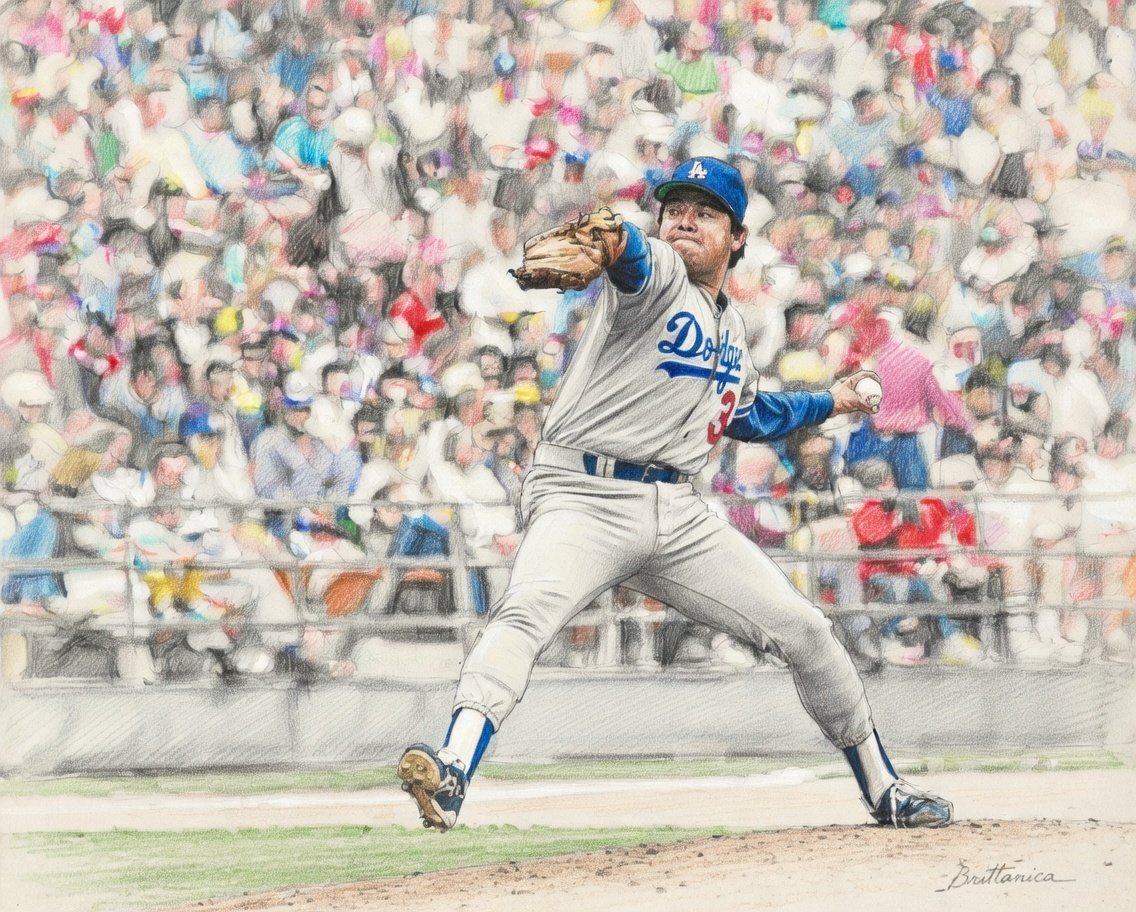
Fernando Valenzuela. Brittanica.
In the spring of 1981, a 20-year-old left-handed pitcher from Sonora, Mexico, ignited a cultural phenomenon that transcended baseball. Fernando Valenzuela, the unassuming rookie for the Los Angeles Dodgers, didn't just win games—he captured hearts, broke barriers, and forever altered the sport's landscape. Dubbed "Fernandomania," his meteoric rise drew record crowds, boosted Latino representation in MLB, and made him a national hero in Mexico. Over a 17-season career, Valenzuela's accomplishments on the mound were matched only by his profound influence on American and Mexican baseball culture, opening doors for generations of Latin American players and fostering pride amid adversity.
Valenzuela's journey began in the rural village of Etchohuaquila, Sonora, born on November 1, 1960, to a large farming family. Growing up in poverty, he honed his skills playing baseball with local teams, developing a signature screwball that baffled hitters. At 16, he signed with the Mexican League's Mayos de Navojoa in 1977, quickly rising through the ranks with his deceptive delivery and pinpoint control. By 1979, he joined the Yucatan Leones, posting a 10-12 record with a 2.49 ERA and 141 strikeouts in 181 innings, earning a spot on the Mexican League All-Star team. His talent caught the eye of Dodgers scout Mike Brito, who signed him for $120,000 in July 1979—the highest bonus for a Mexican player at the time. Valenzuela's minor league stint was brief: in 1980 with Double-A San Antonio, he went 13-9 with a 3.10 ERA, setting the stage for his MLB debut.
Called up to the Dodgers on September 15, 1980, Valenzuela pitched 17 2/3 scoreless innings in relief, hinting at his potential. But 1981 was his breakout: thrust into the starting rotation due to injuries, he won his first eight starts, five shutouts, with a 0.50 ERA. He finished the strike-shortened season 13-7 with a 2.48 ERA, 180 strikeouts in 192 1/3 innings, 11 complete games, and eight shutouts. Valenzuela became the first and only player to win both Rookie of the Year and Cy Young Award in the same season, also earning a Silver Slugger as the NL's top-hitting pitcher. In the postseason, he went 3-1 with a 2.21 ERA, including a complete-game win in Game 3 of the World Series against the Yankees, helping the Dodgers win the championship. He started the 1981 All-Star Game, the first rookie to do so.
Valenzuela's career spanned 17 seasons (1980-1997), mostly with the Dodgers (11 years), but also the Baltimore Orioles, Philadelphia Phillies, San Diego Padres, and St. Louis Cardinals. He compiled a 173-153 record with a 3.54 ERA, 2,074 strikeouts in 2,930 innings, 113 complete games, and 31 shutouts. A six-time All-Star (1981-1986), he led the NL in wins (21) in 1986, complete games (20) that year, and innings pitched (269 1/3). Valenzuela won a Gold Glove in 1986 and two Silver Sluggers (1981, 1983), showcasing his hitting prowess with 10 career home runs. His 41.5 WAR is the highest for a Mexican-born player. In 1990, he threw a no-hitter against the Cardinals on June 29, a 6-0 win.
Valenzuela's impact on American baseball culture was revolutionary. Fernandomania swept Los Angeles and beyond in 1981, drawing record crowds—Dodger Stadium attendance jumped 20%, with Mexican-American fans surging from 30% to nearly 50% of the base. His games boosted Spanish-language broadcasts, expanding MLB's reach to Latino audiences and increasing merchandise sales. As the first Mexican-born star in MLB, he broke stereotypes, inspiring Latinos amid immigration debates. Valenzuela's success diversified fanbases, paving the way for stars like Adrián González. Culturally, he humanized Mexican immigrants, his humility and work ethic resonating in Reagan-era America.
In Mexico, Valenzuela became a national icon, sparking baseball's popularity and inspiring players like Esteban Loaiza. His achievements fostered pride, with MLB games broadcast nationwide. Valenzuela's legacy includes inductions into the Latino Baseball Hall of Fame (2011), Caribbean Baseball Hall of Fame (2013), and Mexican Baseball Hall of Fame (2014). The Dodgers retired his No. 34 in 2023. Though not in Cooperstown, his 104 ERA+ and cultural impact argue for it.
Valenzuela's post-career work as a broadcaster and philanthropist continues his legacy, a testament to how one player's brilliance can bridge cultures and inspire nations.
