
One Man's Run: The Cultural Physics of Linsanity
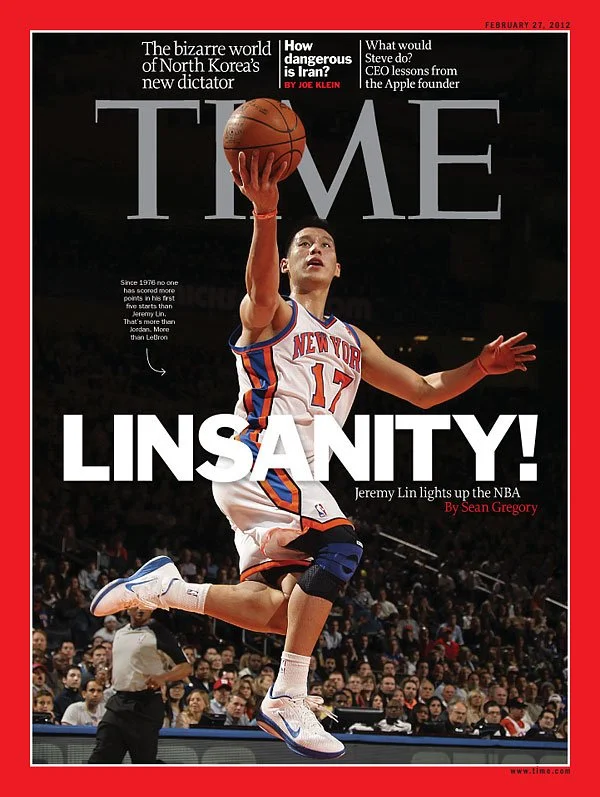
Jeremy Lin on Time Magazine. Time Magazine
The date: February 4, 2012. Madison Square Garden.
A nondescript point guard, fresh off the bench, cut from two teams, entered the game. The New York Knicks were reeling. A forgotten man.
His name was Jeremy Lin.
What happened next, they called "Linsanity." A supernova. An improbable, undeniable, almost mystical ascent from obscurity to global phenomenon. A fairy tale, spun on the hardwood of the NBA.
But that is not the story.
That is the highlight reel. The surface shimmer.
The real narrative, the subterranean tremor that truly shook the world, was a far more complex, a far more geopolitical event than most ever realized. This was not just a basketball player hitting a few clutch shots. This was a precision-guided munition detonating in the heart of deeply entrenched global narratives.
Here's a thought experiment. Imagine you are a state department official, analyzing soft power projections. You track cultural influence, brand perception, the subtle tug-of-war for global hearts and minds.
Then, Jeremy Lin happens.
His ethnicity was not a footnote. It was the headline. An American-born Taiwanese-American, defying every stereotype about Asian athletes in a league dominated by specific archetypes.
This wasn't just about breaking a glass ceiling in sports. This was about cognitive dissonance on a global scale.
For decades, the narrative in popular Western culture, often consumed globally, had painted a picture. Asian individuals were brilliant scholars, engineers, musicians. But not athletes, not alpha competitors in the most physical, visible, culturally dominant sport.
This was not a casual observation. This was a deeply ingrained, almost subconscious, cultural script. A quiet form of soft-power messaging.
Then, Lin took the court.
He didn't just play well. He took over games. He dominated. He outmaneuvered, outscored, out-thought opponents. He became the undisputed leader of the league's most iconic franchise, in the world's media capital.
The implications rippled out.
In Asia, a continent hungry for positive, modern representation on the global stage, Linsanity was less a phenomenon and more a revelation. It was validation. It was a potent counter-narrative to decades of subtle, and not-so-subtle, cultural subordination.
This was a victory in a different kind of war. A war of perception. A battle for cultural parity.
Think of it. Here was a young man, breaking barriers, not with a diplomatic envoy, not with economic policy, but with a basketball.
His success, his sheer, undeniable talent, became a powerful statement. It cut through preconceived notions like a hot knife through butter. It didn't just challenge stereotypes; it obliterated them.
This wasn't just good sports. This was good geopolitics.
It offered a new lens through which to view Asian talent and capability. It changed conversations at dinner tables in Beijing, Taipei, Seoul, and San Francisco. It showed a generation of young Asian people, both in their home countries and in the diaspora, that the limits they perceived were not real.
They were imposed.
His impact was a butterfly effect. A single, improbable flap of a butterfly's wing in New York created a hurricane of cultural reassessment across the Pacific.
What does this have to do with war? Not the kinetic, bombs-and-bullets kind. But the war of ideas. The competition for influence. The projection of strength and capability that isn't always measured in military might.
In the 21st century, cultural exports are weapons. Hollywood, pop music, fast food – they all carry implicit messages about the originating culture. They shape perceptions. They build alliances, or resentments.
Lin's rise was an unexpected, powerful cultural export. It was a message that resonated deeply, particularly in a region often caught between rising global powers.
It was a testament to individual merit, breaking through systemic bias.
It became a symbol of potential, not just for a player, but for a people. A nation. A continent.
His story transcended basketball. It became a powerful narrative about identity, representation, and aspiration. It was a counter-punch to the subtle, insidious cultural wars fought in media and popular imagination.
His improbable run was not just a feel-good story; it was an affirmation. An assertion. A declaration.
A declaration that talent knows no race, no predefined box.
That leadership is earned, not assigned.
That unexpected heroes can emerge from anywhere, and shatter everything you thought you knew.
And in a world perpetually grappling with questions of power, influence, and who gets to define the narrative, Jeremy Lin didn't just score points.
He won a battle. A silent, profoundly important victory in the grand, ongoing geopolitical chess match. He leveraged fame into a precision-guided munition that hit its mark, precisely and powerfully, changing the game far beyond the hardwood.
That is not courage. That is cultural physics.
His legacy isn't just about the numbers. It's about the seismic shift in perspective. The quiet re-evaluation that happened in millions of minds.
He didn't just inspire kids to play basketball. He inspired them to challenge the narratives handed to them. To redefine their own possibilities.
And sometimes, that kind of inspiration is the most powerful weapon of all.

New York Knicks point guard Jeremy Lin reacts after hitting a three-point shot against the Dallas Mavericks in the fourth quarter of their NBA basketball game at Madison Square Garden in New York on February 19, 2012. Photo: Reuters