
One Last Roar: Nicklaus’s Epic Back-Nine Surge at the 1986 Masters
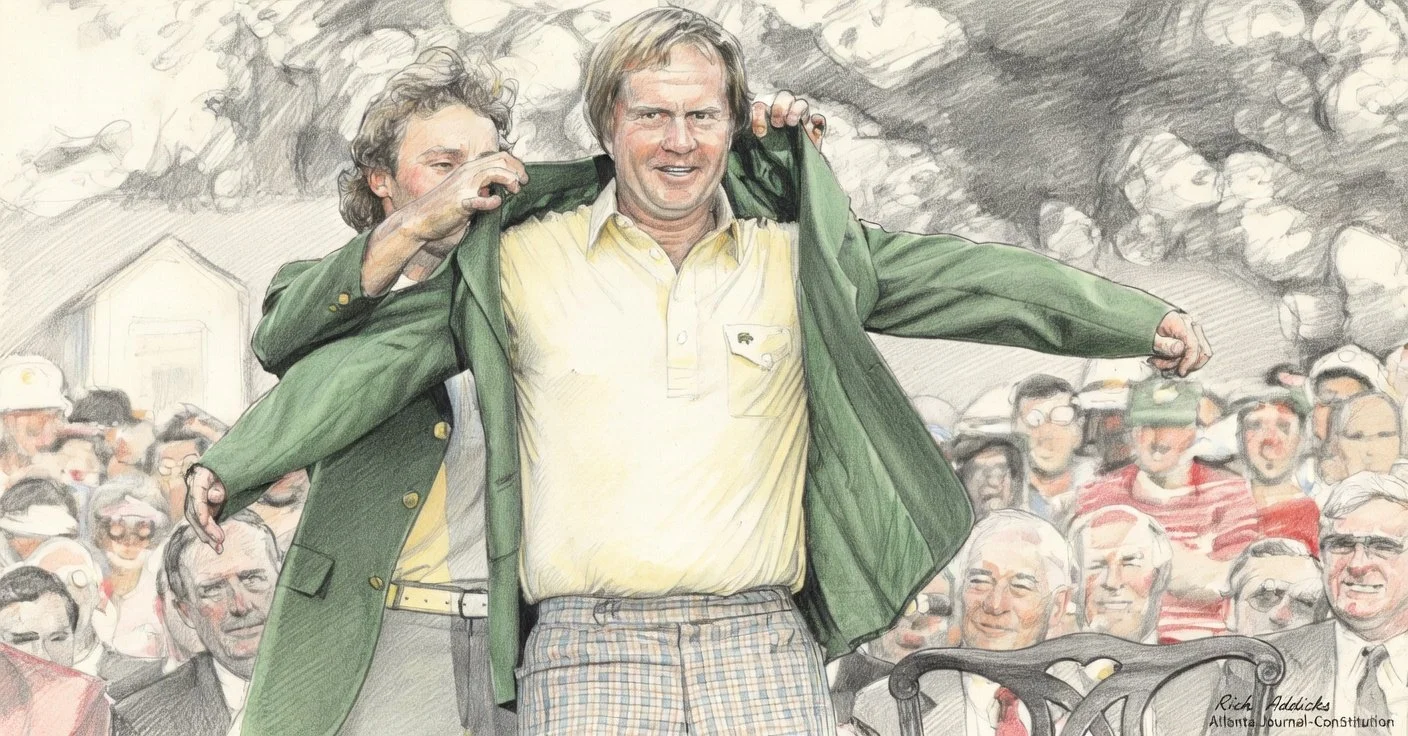
On a sun-drenched Sunday in April 1986, Augusta National Golf Club witnessed one of the most improbable and emotional comebacks in sports history. Jack Nicklaus, the 46-year-old Golden Bear, was largely written off by the golf world. He had not won a major in six years. His form in 1986 was ordinary at best — three missed cuts in seven PGA Tour starts. Many believed his time as a serious contender had passed.
Yet on that unforgettable final day, Nicklaus delivered a performance that transcended golf. Trailing by four shots entering the final round, he shot a blistering 7-under-par 65, including a back-nine 30, to claim his record sixth Green Jacket and 18th professional major championship. It remains one of the greatest closing rounds in major championship history and a defining moment of sports nostalgia.
The Setup: A Legend on the Brink
Nicklaus arrived at Augusta National for his 28th Masters appearance with modest expectations. His first two rounds were solid but unspectacular: a 74 and a 71 left him at 1-under par, six shots behind the co-leaders. A third-round 69 moved him to 4-under for the tournament, but he still sat four strokes behind the leaders heading into Sunday.
The leaderboard was stacked with the game’s best young talent. Seve Ballesteros, the charismatic Spaniard and two-time Masters champion, was playing with fire. Greg Norman, the charismatic Australian known as the Great White Shark, was in peak form. Tom Kite, a steady American contender, lurked dangerously. Nick Price had set a new course record with a 63 in the third round. Even Tom Watson, a multiple major winner, was in the mix.
At 46, Nicklaus looked every bit the elder statesman. His hair was graying, his waistline had thickened slightly, and the powerful, athletic swing that once intimidated opponents now seemed a step slower. Most observers figured he was there for the tradition — perhaps a ceremonial role in the future — not for contention.
Nicklaus himself later admitted he felt something stirring. “I kept thinking all week… I’m not done,” he recalled. His son Jackie, serving as caddie, provided quiet encouragement. Father and son shared a special bond that week, one that would make the victory even sweeter.
The Final Round: A Slow Start Turns Electric
Nicklaus teed off in the second-to-last group on Sunday. For the first eight holes, he played steady but uninspiring golf — one birdie, one bogey, even par. He remained four shots back, and television coverage barely showed him. The drama was centered on Ballesteros, Norman, and Kite.
Then came the turning point. On the par-4 9th hole, after Ballesteros and Kite had both eagled the par-5 8th ahead of him, Nicklaus stepped up. The gallery had been noisy; he backed off his shot twice. Turning to the crowd with a smile, he said, “You’ve heard all that noise from them — let’s see if we can make some noise ourselves.” He striped his approach and rolled in the birdie putt. The roar was deafening. Nicklaus was off and running.
Birdies followed at 10 and 11. A bogey on the treacherous par-3 12th dropped him back temporarily, but he responded with a birdie at the par-5 13th. He was now in the conversation.
The real explosion came on the back nine’s iconic stretch.
At the par-5 15th, Nicklaus smashed a drive and faced 212 yards to the pin. He pulled a 4-iron, flushed it, and watched the ball settle just 12 feet from the hole. The eagle putt was pure. As the ball dropped, CBS announcer Jim Nantz (then a young reporter) and the gallery erupted. Nicklaus pumped his fist; his son Jackie leaped in the air. The Golden Bear had reached 7-under for the round.
Momentum was now unstoppable. At the par-3 16th, he hit a precise 5-iron to about 5 feet and drained the birdie putt. The roar shook the pines. On 17, another birdie from 18 feet sent him to 8-under for the day and 9-under for the tournament.
Nicklaus stood on the 18th tee needing a par to take the outright lead. He chose a 3-wood off the tee for control, then hit a 5-iron approach that landed on the lower tier of the green, leaving a long, uphill putt of nearly 50 feet. The putt tracked beautifully before lipping out by inches. He tapped in for par and a final-round 65. His total: 279, 9-under par.
As he walked off the green, the embrace with Jackie was pure emotion — a father and son sharing a moment that golf fans still replay decades later.
The Drama Behind Him
While Nicklaus was charging, chaos unfolded ahead. Ballesteros, leading by two at one point, found trouble on 15. After a wayward drive, he faced a risky second shot over Rae’s Creek. He went for it aggressively but pushed it into the water. The ensuing bogey (some called it a mental lapse) dropped him back. He finished at 7-under, two shots behind.
Greg Norman, playing in the final group, reached the 18th needing a birdie to tie. From the middle of the fairway, his approach sailed right into a bunker. He made bogey, finishing tied with Kite at 8-under for second place.
Nicklaus had done what few thought possible: he passed five different players who held or shared the lead that day.
Why It Mattered: More Than Just a Win
At 46 years and 82 days old, Nicklaus became the oldest Masters champion in history (a record that still stands). It was his sixth Green Jacket — still the all-time record — and his 18th major title, cementing his status as the greatest golfer of all time for many.
The victory carried deep cultural resonance. In an era when younger stars like Ballesteros and Norman represented the future, Nicklaus proved experience, heart, and clutch putting could still conquer youth and power. It was a story of resilience, belief, and one final roar from a champion who refused to fade quietly.
The moment also highlighted the special father-son dynamic. Jackie Nicklaus later said the week was one of the greatest experiences of his life. For Jack, winning with his son on the bag made it profoundly personal.
CBS’s legendary call by Verne Lundquist on the 16th-hole birdie putt — “Yes sir!” — became immortal, replayed endlessly as the perfect soundtrack to the charge.
Legacy of the 1986 Masters
Forty years later, the 1986 Masters remains golf’s ultimate comeback tale. Nicklaus himself has often said he is amazed not that he won, but that a 65 was exactly the score he needed. “Where would I come up with 65?” he once wondered.
The win capped an extraordinary career that began with his first major in 1962. It also gave fans one last iconic image of the Golden Bear in his prime form — pumping his fist, walking up the 18th fairway to thunderous applause, and slipping into that sixth Green Jacket.
For sports fans who cherish nostalgia, Nicklaus’s 1986 triumph stands alongside other legendary moments: Willis Reed limping onto the court, Michael Jordan’s flu game, or Tiger Woods’s 1997 Masters. It reminds us that legends don’t always go gently into the night. Sometimes, they summon one final burst of greatness that echoes through time.
Even today, when older golfers contend at majors or fans debate the GOAT between Nicklaus and Woods, the 1986 Masters is invoked as proof that age is just a number when heart and skill align.
Jack Nicklaus didn’t just win the 1986 Masters. He reminded the world why we fall in love with sports — for those rare, spine-tingling moments when the impossible becomes real, and a 46-year-old legend writes one last unforgettable chapter.
